Florida Memory is administered by the Florida Department of State, Division of Library and Information Services, Bureau of Archives and Records Management. The digitized records on Florida Memory come from the collections of the State Archives of Florida and the special collections of the State Library of Florida.
Decades of tension between the northern and southern states finally boiled over into war in 1861 when South Carolina, Mississippi, Florida, Alabama, Georgia, Louisiana and Texas seceded from the United States and formed the Confederate States of America. The North and South had developed notable differences socially, economically and politically. The most significant difference was their opinions on slavery and the right of the federal government to stop its spread.
On April 12, 1861, the Confederacy attacked Fort Sumter in South Carolina, leading to four years of war between the Union and Confederacy. The fighting came to an end in 1865, and President Andrew Johnson formally declared the end of the war in August 1866. Historians find it hard to estimate the total number of deaths because of issues with recordkeeping, but most agree between 600,000 and 700,000 soldiers died alongside an untold number of civilians.
The period after the Civil War is called Reconstruction. From 1865 to 1877, the federal government worked to rebuild the nation and readmit former Confederate states to the United States. In addition, around 4 million African Americans had been freed from slavery and began building new lives with many registering to vote and running for office. Some objected to these changes. New laws called Jim Crow in the South pushed back against these new freedoms, and groups like the Ku Klux Klan used violence to maintain racial barriers in American life.
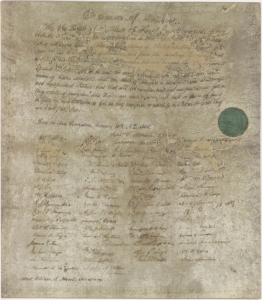
Florida Convention of the People, Ordinance of Secession, 10 January 1861, Florida Memory, State Archives of Florida, Series S972, s972_b001_01.
January 10, 1861
Secession Convention in Tallahassee
Following President Abraham Lincoln's election, Florida Governor Madison Starke Perry called for Florida to prepare for secession. A convention of delegates met in Tallahassee on January 10, 1861, and voted to adopt an ordinance of secession.
Identify the division (Confederate and Union States, Border states, western territories) of the United States at the outbreak of the Civil War.
02/14
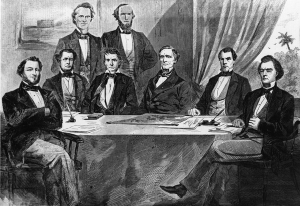
The Cabinet of the Confederate States at Montgomery, 1861, Florida Memory, Reference Collection, RC05595.
February 4, 1861
Secession Convention in Montgomery
At a meeting in Montgomery, Alabama, on February 4, 1861, representatives from Alabama, Georgia, Louisiana, Mississippi, South Carolina, Texas and Florida drafted a provisional constitution for the Confederate States.
Identify the division (Confederate and Union States, Border states, western territories) of the United States at the outbreak of the Civil War.
02/14
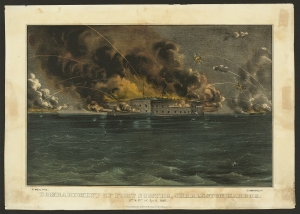
Currier & Ives, Bombardment of Fort Sumter, Charleston Harbor: 12th & 13th of April, 1861, 1861, Library of Congress, 90711987.
April 12, 1861
Battle of Fort Sumter
On April 12, 1861, the American Civil War officially began with the Battle of Fort Sumter near Charleston, South Carolina, when Confederate forces opened fire on the fort. The U.S. Army surrendered the next day and evacuated.
Compare significant Civil War battles and events and their effects on civilian populations.
Examples may include, but are not limited to, Fort Sumter, Bull Run, Monitor v. Merrimack, Antietam, Vicksburg, Gettysburg, Emancipation Proclamation, Sherman's March, Lee's surrender at Appomattox.
02/14
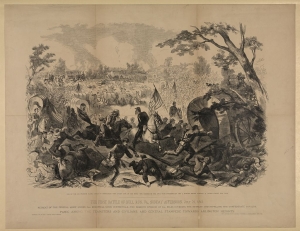
The First Battle of Bull Run, Va., Sunday Afternoon, July 21, 1861, Library of Congress, 2003681590.
July 21, 1861
The First Battle of Bull Run
On the morning of July 21, 1861, the first major battle of the Civil War began at Bull Run, a river in Virginia. Under the command of P. G. T. Beauregard, the Confederate forces defeated the Union. President Lincoln and his administration realized that the war would not be over quickly.
Learn More
William J. Cooper and James J. Cooke, "First Battle of Bull Run," EBSCO Research Starters, last modified 2023.
Compare significant Civil War battles and events and their effects on civilian populations.
Examples may include, but are not limited to, Fort Sumter, Bull Run, Monitor v. Merrimack, Antietam, Vicksburg, Gettysburg, Emancipation Proclamation, Sherman's March, Lee's surrender at Appomattox.
02/14
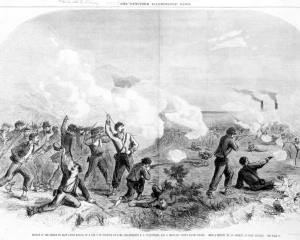
Defeat of the Rebels on Santa Rosa Island, By a Party of Wilson's Zouaves, 6th Regiment New York Volunteers, October 1861, Florida Memory, Reference Collection, RC11040.
October 9, 1861
Battle of Santa Rosa Island
Over 1,000 Confederate soldiers crossed Pensacola Bay late in the evening on October 8, 1861, and began attacking the Union in the early hours of October 9. The Confederates failed to take Fort Pickens. The fort was one of four Southern forts that remained in Union hands throughout the war.
Describe Florida's involvement (secession, blockades of ports, the battles of Ft. Pickens, Olustee, Ft. Brooke, Natural Bridge, food supply) in the Civil War.
Additional examples may also include, but are not limited to, Ft. Zachary Taylor, the plantation culture, the First Florida Cavalry.
Compare significant Civil War battles and events and their effects on civilian populations.
Examples may include, but are not limited to, Fort Sumter, Bull Run, Monitor v. Merrimack, Antietam, Vicksburg, Gettysburg, Emancipation Proclamation, Sherman's March, Lee's surrender at Appomattox.
02/14
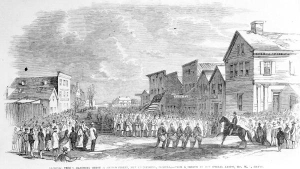
National Troops Marching Through Second Street - New Fernandina, Florida, 1862, Florida Memory, Reference Collection, RC04644.
March 3, 1862
Union Captures Fort Clinch on Amelia Island
The Confederates seized Fort Clinch in 1861 but abandoned it in March after a string of defeats in Tennessee weakened their forces. This allowed the Union to take control of the fort. It became a refuge for hundreds of enslaved people who fled Florida and southeast Georgia.
Describe Florida's involvement (secession, blockades of ports, the battles of Ft. Pickens, Olustee, Ft. Brooke, Natural Bridge, food supply) in the Civil War.
Additional examples may also include, but are not limited to, Ft. Zachary Taylor, the plantation culture, the First Florida Cavalry.
Compare significant Civil War battles and events and their effects on civilian populations.
Examples may include, but are not limited to, Fort Sumter, Bull Run, Monitor v. Merrimack, Antietam, Vicksburg, Gettysburg, Emancipation Proclamation, Sherman's March, Lee's surrender at Appomattox.
02/14
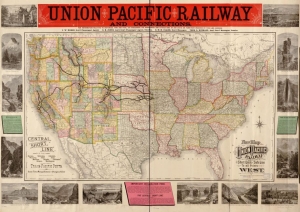
New Map of the Union Pacific Railway, the Short, Quick and Safe Line to All Points West, [1883], Library of Congress, 98688838.
July 1, 1862
President Lincoln Signs the Pacific Railway Act
On July 1, 1862, President Lincoln signed the Pacific Railway Act, supporting the construction of a transcontinental railroad that would connect the Missouri River to the Pacific Ocean. Construction technically began in 1863, but most of the work was completed after the Civil War.
Learn More
"Pacific Railway Act (1862)," U.S. National Archives and Records Administration, last modified May 10, 2022.
Standards related to 19th-century transportation and communication advancements and their economic impact
Examine 19th century advancements (canals, roads, steamboats, flat boats, overland wagons, Pony Express, railroads) in transportation and communication.
In addition to those listed in the benchmark, examples may include, but are not limited to, the telegraph, Morse Code.
02/14
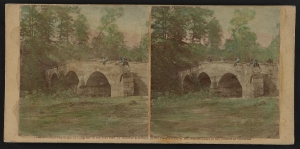
Burnside Bridge, Eastern View, ca. 1862, Library of Congress, Civil War Photograph Collection, 2011646193.
September 17, 1862
Battle of Antietam (or Sharpsburg)
On September 17, 1862, Union and Confederate forces clashed near the mouth of Antietam Creek near the town of Sharpsburg, Maryland. The Battle of Antietam is recognized today as the bloodiest single-day battle in U.S. history. More than 22,000 Union and Confederate soldiers were killed or injured, and many local citizens helped care for the wounded or bury the dead. Civilians also lost land, horses and crops because of the battle.
Learn More
Ralph L. Eckert, "Battle of Antietam," EBSCO Research Starters, last modified 2022.
Compare significant Civil War battles and events and their effects on civilian populations.
Examples may include, but are not limited to, Fort Sumter, Bull Run, Monitor v. Merrimack, Antietam, Vicksburg, Gettysburg, Emancipation Proclamation, Sherman's March, Lee's surrender at Appomattox.
02/14
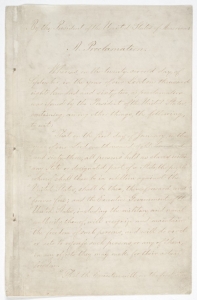
Emancipation Proclamation, 1 January 1863, National Archives at Washington, DC, 299998.
January 1, 1863
Emancipation Proclamation
On January 1, 1863, President Abraham Lincoln issued the Emancipation Proclamation. It declared that all enslaved people within rebellious states (the Confederacy) were freed. It did not end slavery in the places that were already under Union control.
Explain major domestic and international economic, military, political, and socio-cultural events of Abraham Lincoln's presidency.
Examples may include, but are not limited to, sectionalism, states' rights, slavery, Civil War, attempts at foreign alliances, Emancipation Proclamation, Gettysburg Address, suspension of habeas corpus, First and Second Inaugural Addresses.
Compare significant Civil War battles and events and their effects on civilian populations.
Examples may include, but are not limited to, Fort Sumter, Bull Run, Monitor v. Merrimack, Antietam, Vicksburg, Gettysburg, Emancipation Proclamation, Sherman's March, Lee's surrender at Appomattox.
02/14
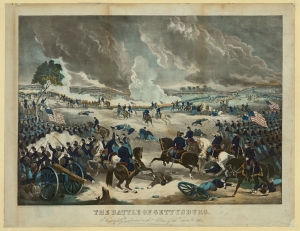
Thomas Kelly, The Battle of Gettysburg, ca. 1867, Library of Congress, 2006681070.
July 3, 1863
Union Wins the Battle of Gettysburg
The Battle of Gettysburg started on July 1, 1863, and lasted three days. It was a turning point for the Union in the Civil War, though both sides suffered heavy losses. The Florida Brigade suffered a higher loss rate than any other Confederate brigade in the battle.
Explain major domestic and international economic, military, political, and socio-cultural events of Abraham Lincoln's presidency.
Examples may include, but are not limited to, sectionalism, states' rights, slavery, Civil War, attempts at foreign alliances, Emancipation Proclamation, Gettysburg Address, suspension of habeas corpus, First and Second Inaugural Addresses.
02/14
Siege of Vicksburg, c. 5 July 1888, Library of Congress, 2003663945.
July 4, 1863
Union Victory at the Siege of Vicksburg
From May to July 1863, the U.S. Army laid siege to the town of Vicksburg, Mississippi. Many civilians took shelter from the constant gunfire in dugout caves. The Confederate Army surrendered to General Ulysses S. Grant on July 4.
Compare significant Civil War battles and events and their effects on civilian populations.
Examples may include, but are not limited to, Fort Sumter, Bull Run, Monitor v. Merrimack, Antietam, Vicksburg, Gettysburg, Emancipation Proclamation, Sherman's March, Lee's surrender at Appomattox.
02/14
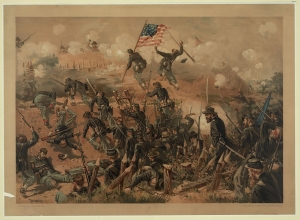
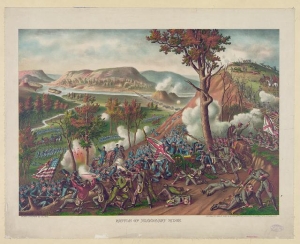
Kurz & Allison, Battle of Missionary Ridge - Fought November 23-25, 1863, c1886, Library of Congress, 91480843.
November 25, 1863
Union Wins the Battle of Missionary Ridge
On November 25, 1863, Union forces broke through the Confederate's line of defense at Missionary Ridge and ended their siege of Chattanooga, Tennessee. Among the Confederate troops at Missionary Ridge were five of Florida's infantry regiments and the 1st Florida Cavalry, Dismounted, which means they fought on foot rather than horseback.
Compare significant Civil War battles and events and their effects on civilian populations.
Examples may include, but are not limited to, Fort Sumter, Bull Run, Monitor v. Merrimack, Antietam, Vicksburg, Gettysburg, Emancipation Proclamation, Sherman's March, Lee's surrender at Appomattox.
Describe Florida's involvement (secession, blockades of ports, the battles of Ft. Pickens, Olustee, Ft. Brooke, Natural Bridge, food supply) in the Civil War.
Additional examples may also include, but are not limited to, Ft. Zachary Taylor, the plantation culture, the First Florida Cavalry.
02/14
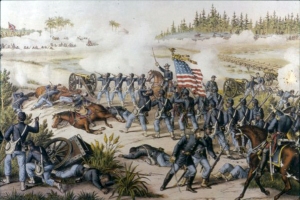
Kurz & Allison Lithographic Print of the Battle at Olustee - Olustee Battlefield, Florida, 1894, Florida Memory, General Collection, N046635.
February 20, 1864
Battle of Olustee
The largest battle of the Civil War in Florida took place in a pine forest near Olustee in Baker County. Among the Union forces were three regiments of Black soldiers, including the 1st North Carolina Colored Infantry, the 8th U.S. Colored Infantry, and the 54th Massachusetts Volunteer Infantry.
Describe Florida's involvement (secession, blockades of ports, the battles of Ft. Pickens, Olustee, Ft. Brooke, Natural Bridge, food supply) in the Civil War.
Additional examples may also include, but are not limited to, Ft. Zachary Taylor, the plantation culture, the First Florida Cavalry.
02/14
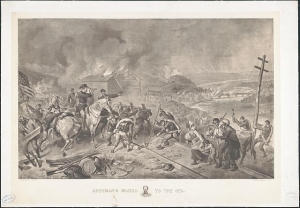
Felix Octavius Carr Darley, Sherman's March to the Sea, c1883, Library of Congress, Popular Graphic Arts Collection, 96512373.
November 15, 1864
Sherman's March to the Sea Begins
Union General William T. Sherman's March to the Sea was one of the most destructive military campaigns against civilians during the Civil War. Starting on November 15, 1864, Sherman and his troops marched from Atlanta to Savannah in a 20-day campaign that destroyed food sources and horrified Georgia's citizens.
Learn More
Anne Bailey, "Sherman's March to the Sea," in New Georgia Encyclopedia (Georgia Humanities, University of Georgia Press, 2020).
Compare significant Civil War battles and events and their effects on civilian populations.
Examples may include, but are not limited to, Fort Sumter, Bull Run, Monitor v. Merrimack, Antietam, Vicksburg, Gettysburg, Emancipation Proclamation, Sherman's March, Lee's surrender at Appomattox.
02/14
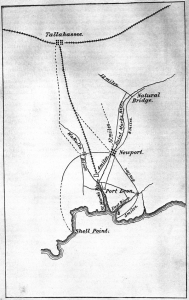
Map of Natural Bridge, in Relation to Tallahassee and Shell Point, 1865 - Leon County, Florida, 1865, Florida Memory, General Collection, N034550.
March 6, 1865
Battle of Natural Bridge
The Battle of Natural Bridge was the last major battle of the Civil War in Florida and the second largest Civil War battle in the state. The battle lasted for a day, ending when the Union retreated.
Describe Florida's involvement (secession, blockades of ports, the battles of Ft. Pickens, Olustee, Ft. Brooke, Natural Bridge, food supply) in the Civil War.
Additional examples may also include, but are not limited to, Ft. Zachary Taylor, the plantation culture, the First Florida Cavalry.
02/14
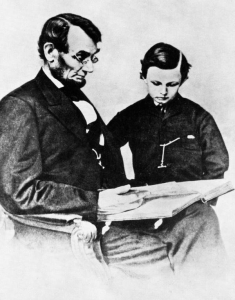
Mathew B. Brady, President Lincoln, With His Son Tad, 6 February 1864, Florida Memory, Print Collection, PR08928.
April 14, 1865
Assassination of Abraham Lincoln
On April 14, 1865, President Abraham Lincoln was shot by John Wilkes Booth at Ford's Theatre in Washington D.C. President Lincoln was carried to a house across the street where doctors continued trying to treat him. At 7:22am on April 15, President Lincoln was pronounced dead.
Explain major domestic and international economic, military, political, and socio-cultural events of Abraham Lincoln's presidency.
Examples may include, but are not limited to, sectionalism, states' rights, slavery, Civil War, attempts at foreign alliances, Emancipation Proclamation, Gettysburg Address, suspension of habeas corpus, First and Second Inaugural Addresses.
02/14
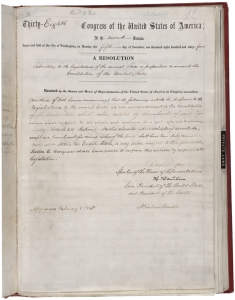
Joint Resolution Proposing the Thirteenth Amendment to the United States Constitution, 31 January 1865, National Archives at Washington, DC, Enrolled Acts and Resolutions of Congress, 1408764.
December 6, 1865
States Ratify the Thirteenth Amendment
When Georgia ratified the Thirteenth Amendment on December 6, 1865, the state provided the final vote necessary for the amendment to become part of the U.S. Constitution. The amendment banned slavery across the United States and in its territories, except as a criminal punishment.
Explain and evaluate the policies, practices, and consequences of Reconstruction (presidential and congressional reconstruction, Johnson's impeachment, Civil Rights Act of 1866, the 13th, 14th, and 15th Amendments, opposition of Southern whites to Reconstruction, accomplishments and failures of Radical Reconstruction, presidential election of 1876, end of Reconstruction, rise of Jim Crow laws, rise of Ku Klux Klan).
Examine social contributions of African Americans post-Civil War.
Clarification 1: Instruction includes how the war effort helped propel civil rights for African Americans from the early Civil Rights Movement (1865-1896) to the modern-day Civil Rights Movement, demanding the American promise of justice, liberty and equality (i.e., 13th Amendment, 14th Amendment, 15th Amendment).
Clarification 2: Instruction includes the founding of Historically Black Colleges and Universities (HBCUs).
Clarification 3: Instruction includes fraternal and sororal organizations.
05/24
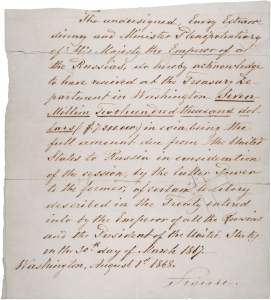
Draft for Payment for the Purchase of Alaska, 1 August 1868, National Archives at Washington, DC, 301666.
March 30, 1867
The Alaska Purchase
U.S. Secretary of State William H. Seward purchased Alaska from Russia on March 30, 1867, for $7.2 million. Some Americans saw the potential for gold, fur, fisheries and trade with Asia, while others thought the land was useless.
Explain the motives of the United States acquisition of the territories.
Examples may include, but are not limited to, Alaska, Hawaii, Puerto Rico, Philippines, Guam, Samoa, Marshall Islands, Midway Island, Virgin Islands.
02/14
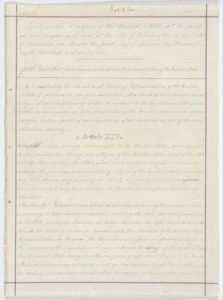
Joint Resolution Proposing the Fourteenth Amendment to the United States Constitution, 13 June 1866, National Archives at Washington, DC, 1408913.
July 9, 1868
States Ratify the Fourteenth Amendment
Ratified on July 9, 1868, the Fourteenth Amendment contains five sections. The most well-known sections are those that grant citizenship to all people born or naturalized in the United States and guarantee all citizens the right to due process and equal protection under the law.
Explain and evaluate the policies, practices, and consequences of Reconstruction (presidential and congressional reconstruction, Johnson's impeachment, Civil Rights Act of 1866, the 13th, 14th, and 15th Amendments, opposition of Southern whites to Reconstruction, accomplishments and failures of Radical Reconstruction, presidential election of 1876, end of Reconstruction, rise of Jim Crow laws, rise of Ku Klux Klan).
02/14
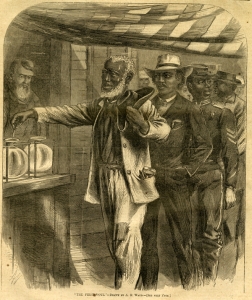
Alfred R. Waud, The First Vote of African Americans in Virginia, 1867, Florida Memory, Digital Collection, DLN004262.
February 3, 1870
States Ratify the Fifteenth Amendment
On February 3, 1870, the Fifteenth Amendment was ratified, stating that the right to vote in the United States could not be denied based on race, color or former enslavement. As a result, African American men were guaranteed the right to vote in the U.S. Constitution, but Black Codes, Jim Crow laws and groups like the Ku Klux Klan prevented African American voters from exercising their rights.
Explain and evaluate the policies, practices, and consequences of Reconstruction (presidential and congressional reconstruction, Johnson's impeachment, Civil Rights Act of 1866, the 13th, 14th, and 15th Amendments, opposition of Southern whites to Reconstruction, accomplishments and failures of Radical Reconstruction, presidential election of 1876, end of Reconstruction, rise of Jim Crow laws, rise of Ku Klux Klan).
02/14
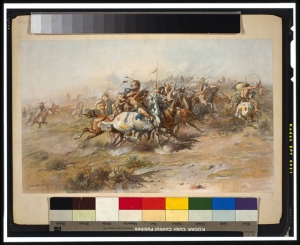
Charles M. Russell, The Custer Fight, ca. 1905, Library of Congress, 99472670.
June 25, 1876
Battle of the Little Bighorn
The Battle of the Little Bighorn began on June 25, 1876. The battle was part of the U.S. government's attempts to force Native Americans in the region to move onto reservations. Led by Lieutenant Colonel George Armstrong Custer, the U.S. 7th Cavalry Regiment attacked a Lakota, Dakota, Northern Cheyenne and Arapaho camp near the Little Bighorn River in the Montana Territory. Custer and his men were quickly defeated, leading to the name "Custer's Last Stand."
Learn More
W. Turrentine Jackson, Sharon K. Wilson, and Raymond Wilson, "Battle of the Little Bighorn," EBSCO Research Starters, last modified 2023.
Examples may include, but are not limited to, westward expansion, reservation system, the Dawes Act, Wounded Knee Massacre, Sand Creek Massacre, Battle of Little Bighorn, Indian Schools, government involvement in the killing of the buffalo.
02/14
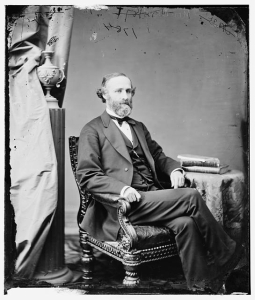
Hon. Henry Laurens Dawes of Mass., [between 1860 and 1875], Library of Congress, Brady-Handy Photograph Collection, 2017894082.
February 8, 1887
President Cleveland Signs the Dawes Act
On February 8, 1887, President Grover Cleveland signed the Dawes Act, which allowed the U.S. government to break up tribal lands and give Native families their own plots. All remaining land would then be sold to non-Native settlers. The Dawes Act weakened Native communities and governments, and it also led to the loss of almost 150 million acres of Native land.
Learn More
"Dawes Act (1887)," U.S. National Archives and Records Administration, last modified February 8, 2022.
"The Dawes Act," National Park Service, last modified July 9, 2021.
Standards related to the Native American experience during the Civil War and Reconstruction
Examples may include, but are not limited to, westward expansion, reservation system, the Dawes Act, Wounded Knee Massacre, Sand Creek Massacre, Battle of Little Bighorn, Indian Schools, government involvement in the killing of the buffalo.
These primary source sets contain documents and photos arranged by topic that teachers can use in their lesson plans. Each set is accompanied by a teacher's guide containing historical context, teaching suggestions, and relevant NGSSS and Florida Standards.

 Listen: The World Program