Florida Memory Timeline Challenge banner image with vertical American flag background and smaller images in a line, including a map of Florida, Mary McLeod Bethune, people celebrating V-J Day, Betty Mae Tiger Jumper, and the Challenger space shuttle launch.

European Exploration and Colonization

From the 15th to the 18th century, European nations set out to expand their power by creating colonies in other parts of the world. Christopher Colmbus famously landed in what is now the Bahamas in 1492, starting the era of colonialism in the Americas. After Columbus' famous first voyage, more Europeans began conquering the Americas and establishing their own colonies.

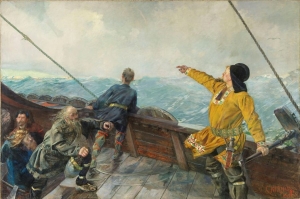
Oil painting that depicts Leif Erikson and his crew onboard a ship.
Christian Krohg, Leiv Eiriksson Discovering America, 1893, Nasjonalmuseet [National Museum], NG.M.00558.
1000
Leif Erikson Explores North America

Around 1000 C.E., Leif Erikson and his crew landed in an area covered in rocks and glaciers he called Helluland. Historians think Helluland included modern day Baffin Island and the Torngat Mountains, an Inuit homeland. This would make Erikson and his crew the first Europeans to explore the continent now known as North America.

Learn More

  • Birgitta Wallace, "Leif Eriksson," in The Canadian Encyclopedia (Historica Canada, 2006), accessed December 5, 2025.
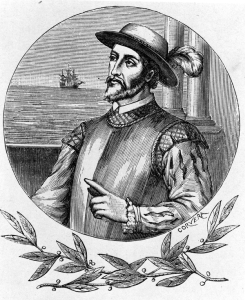
Juan Ponce de León.
Corvera, Juan Ponce de Leon, circa 1893, Florida Memory, Reference Collection, RC00973.
1513
Ponce de León Claims Florida for Spain

Juan Ponce de León and his men landed on the east coast of Florida in April 1513. The Spanish Empire wanted to expand their territory and build their wealth by claiming new land. Legend also says Ponce de León was searching for the Fountain of Youth.

Learn More

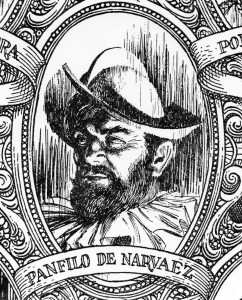
Pánfilo de Narváez.
Drawing of Panfilo de Narvaez, 1890 (circa), Florida Memory, Reference Collection, RC07568.
April 12, 1528
Narváez Expedition Arrives in Florida

The Narváez expedition left Spain on June 17, 1527, with the goal of exploring Florida and building colonial settlements. Led by Pánfilo de Narváez, the original group was made up of about 600 people. After making stops in Hispaniola and Cuba, more than 100 people abandoned the expedition. A hurricane also destroyed several ships. What was left of the group arrived in Florida on April 12, 1528.

Learn More

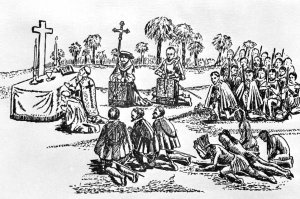
Drawing of an outdoor Christmas mass with an altar, cross, gathered worshippers and a few Native people.
Drawing Depicting Christmas Mass Celebration in What is Now the United States, 25 December 1539, Florida Memory, Print Collection, PR11395.
December 25, 1539
First Known Florida Christmas

On the hunt for gold and other precious metals, Spanish conquistador Hernando de Soto arrived in Florida in 1539 with an expedition of more than 600 enslaved people, craftsmen and soldiers. Settling in for the winter, they occupied Anhaica, an Apalachee town, from October 6, 1539, to March 3, 1540.

Learn More

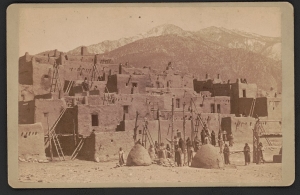
Multistoried adobe pueblo with a group of Native people posing in the foreground.
F. A. Nims and Cunningham & Co., [Taos Pueblo, New Mexico], [between 1880 and 1889], Library of Congress, Marian S. Carson Collection, 2015651512.
August 29, 1540
Spanish Arrive at the Taos Valley

Spanish conquistador Francisco Vázquez de Coronado's expedition arrived at the Taos Valley in 1540. Before the Spanish arrived, it was a central trade point for the Native people now called Pueblo Indians. Today, Taos Pueblo is a National Historic Landmark and one of the best-preserved examples of traditional pueblo structures.

Learn More

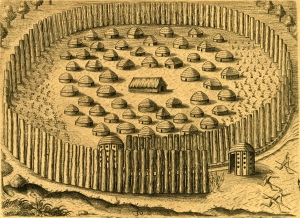
Engraving of an Indigenous town with dome-shaped buildings surrounded by wooden pillars that are arranged in an oval shape.
Theodor de Bry, Construction of the Fortified Towns Among the Floridians, 1591, Florida Memory, Digital Collection, DLN003673.
1562
Saturiwa Meet the French

The land near present-day Jacksonville, Florida, was once home to the main village of a chiefdom (an area ruled by a chief or group of chiefs) called Saturiwa. Part of the Timucua group, the Saturiwa met the French explorer Jean Ribault in 1562 and began an alliance.

Learn More

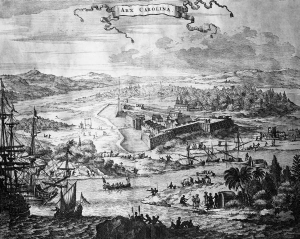
Engraving of a city with fortified triangular walls, ships in the harbor, and groups of people on the shoreline with a background of hills and forests.
Fort Caroline, [1671], Florida Memory, General Collection, N030783.
1564
French Settlers Establish Fort Caroline

Looking to escape persecution and increase the French territories in North America, a few hundred French Protestants led by René Goulaine de Laudonnière established Fort Caroline. The settlers relied heavily on Timucua-speaking tribes and survived for a year before the Spanish attacked.

Learn More

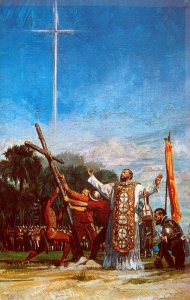
Painting of a Spanish priest on a beach, the conquistador Don Pedro Menendez de Aviles, and a group of men including one Native man raising a wooden cross.
Landing at Nombre de Dios, circa 1900, Florida Memory, Postcard Collection, PC6016.
September 8, 1565
Spanish Establish St. Augustine

Pedro Menéndez de Avilés founded St. Augustine on September 8, 1565, and became the first governor of the colony. Located within Timucua territory, it was the first permanent European settlement in what is now the contiguous (or mainland) United States.

Learn More

  • "St. Augustine," Florida Department of State, accessed August 13, 2025.

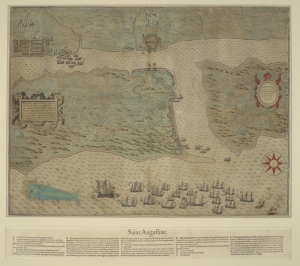
Hand-colored map depicting Sir Francis Drake's attack on Saint Augustine with illustrations telling the story of how the English pirate ship captured and burned the fort and city of St. Augustine.
Baptista Boazio, Saint Augustine Map, 1589, Florida Memory, Collection M81-21, m81-21_b002_01.
May 28, 1586
Sir Francis Drake Attacks Saint Augustine

On May 28 and 29, 1586, at the command of Queen Elizabeth I of England, Sir Francis Drake led an attack on the Spanish city of St. Augustine. St. Augustine was a year old at the time. Today, it is the longest continuously occupied European settlement in North America.

Learn More

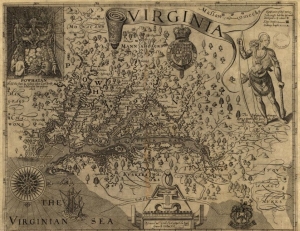
Map of Virginia that depicts the Chesapeake Bay and four major rivers and also includes locations and English-language names of Native groups and towns.
John Smith and William Hole, Virginia, [1624], Library of Congress, 99446115.
May 14, 1607
Virginia Company Settles Jamestown

On May 14, 1607, the Virginia Company of London began to settle a piece of land they called "James His Towne" or Jamestown, after King James I. England wanted to start their own colonies to mine for gold and silver, increase their wealth and power, and compete with other nations, particularly Spain.

Learn More

  • "Jamestown," Library of Congress, accessed August 7, 2025.

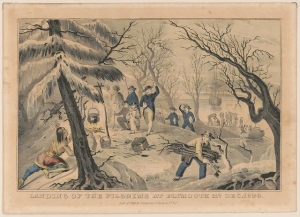
Hand-colored print of a Native man in a snowy landscape watching Pilgrims by a campfire as another man with hatchet gathers firewood and more Pilgrims come ashore from the Mayflower.
N. Currier, Landing of the Pilgrims at Plymouth 11th Dec. 1620, [between 1838 and 1856], Library of Congress, 95503144.
December 21, 1620
Pilgrims Establish Plymouth Colony

The Pilgrims, a group of English settlers fleeing religious persecution in England, crossed the Atlantic Ocean on the Mayflower and established Plymouth Colony in 1620 at the site of an abandoned Patuxet village.

Learn More

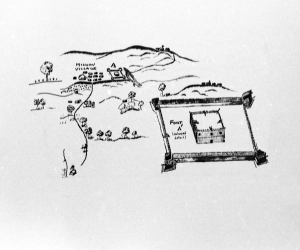
Sketch of Mission San Luis with hilly landscape and buildings labeled mission village in the background and square fort in the foreground.
Map of Mission San Luis, 17 May 1965, Florida Memory, Tallahassee Democrat Collection, TD01831.
1656
Spanish Move Mission San Luis to Tallahassee

In 1656, the Spanish moved the original site of Mission San Luis to the hills of what is now Tallahassee. The Spanish mission system was designed to spread Catholicism and integrate Indigenous people into Spanish society. San Luis was once home to more than 1,500 Apalachee and 150 Spanish people.

Learn More

  • "History," Mission San Luis, accessed August 8, 2025.

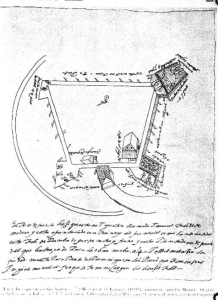
Hand-drawn plan of the fort Castillo de San Marcos that shows the fort's walls, corner bastions, and two interior buildings with cursive annotations in Spanish.
Plan of Castillo de San Marcos, 1593, Florida Memory, Print Collection, PR03391.
October 2, 1672
Construction Begins on Castillo de San Marcos

After multiple attacks on St. Augustine, the Spanish realized they needed stronger defenses to protect the city. Construction on Castillo de San Marcos began in 1672 and would last more than 20 years.

Learn More

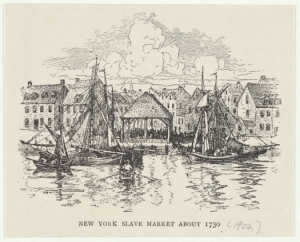
Drawing with ships in the harbor, a market for selling enslaved people, and a crowd of people and buildings along the waterfront.
Harry Fenn, New York Slave Market About 1730, 1902, The New York Public Library Digital Collections, The Miriam and Ira D. Wallach Division of Art, Prints and Photographs: Picture Collection, 807837.
April 6, 1712
Enslaved Africans Rebel in New York City

On the night of April 6, 1712, a group of enslaved Africans in New York City rebelled against slavery. By setting fires as a lure, the group attacked several local white people, killing nine and injuring seven. Out of the 43 enslaved people and one free person put on trial, 25 enslaved people were convicted and sentenced to death.

Learn More

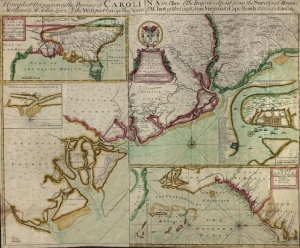
Map of South Carolina showing the settlements of the English, French and Native nations from Charles Town to the Mississippi River.
Edw. Crisp, Thomas Nairne, John Harris, Maurice Mathews, and John Love, A Compleat Description of the Province of Carolina in 3 Parts: 1st, the Improved Part From the Surveys of Maurice Mathews & Mr. John Love: 2ly, the West Part by Capt. Tho. Nairn: 3ly, a Chart of the Coast From Virginia to Cape Florida, [1711?], Library of Congress, 2004626926.
April 15, 1715
Yamasee War Begins

The Yamasee War began on April 15, 1715, when Yamasee attacked a delegation of South Carolina colonists. The war was mainly fought by the Carolinian colonists and the Yamasee, though some neighboring tribes became involved on either side. To escape the war, some Yamasee moved into Spanish Florida and joined the Seminole.

Learn More

  • Michael P. Morris, "Yamassee War," in South Carolina Encyclopedia (University of South Carolina, Institute for Southern Studies, 2022).

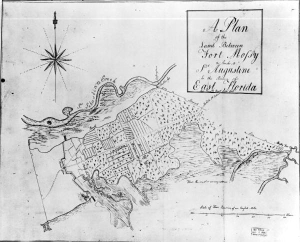
Plan of the land between Fort Mose and Saint Augustine in the province of East Florida depicting marshes, Saint Sebastian Creek, and overgrown fields.
Plan of the Land Between Fort Mossy (Mose) and Saint Augustine, c1765, Florida Memory, Reference Collection, RC12824.
1738
Spanish Build Fort Mose in Florida

In 1738, more than 100 enslaved Africans seeking freedom from British plantations arrived in Spanish Florida. With the help of Governor Manuel Joaquín de Montiano, they began building Gracia Real de Santa Teresa de Mose, or Fort Mose, the first legally sanctioned free Black settlement.

Learn More

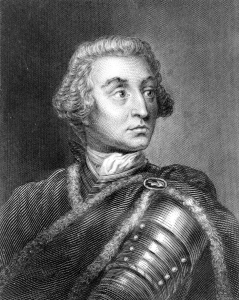
James Edward Oglethorpe.
General James Edward Oglethorpe, circa 1770, Florida Memory, Print Collection, PR07725.
1740
The British Invade St. Augustine

The War of Jenkins' Ear erupted between Great Britain and Spain in 1739. General James Oglethorpe attacked the Spanish fort at St. Augustine in the summer of 1740. The siege lasted a little over a month but ultimately failed.

Learn More

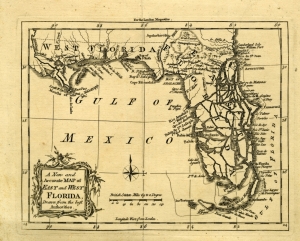
Map of East and West Florida with East and West Florida separated by the Apalachicola River and West Florida extending to the Mississippi River and including New Orleans.
J. Prockter, Map of East and West Florida, 1765, Florida Memory, Florida Map Collection, FMC0262.
1763
Spain Trades Florida to Great Britain

At the end of the French and Indian War and as part of the Treaty of Paris of 1763, Spain gave control of Florida to Great Britain who then divided the colony into East Florida and West Florida. West Florida also included land from French Louisiana.

Learn More

  • Charles H. O’Brien, "Peace of Paris," EBSCO Research Starters, last modified 2023.

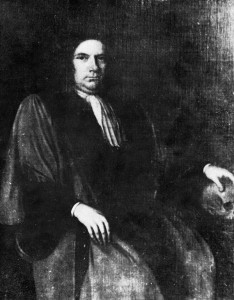
Dr. Andrew Turnbull.
Portrait of Dr. Andrew Turnbull - New Smyrna, Florida, circa 1870, Florida Memory, Reference Collection, RC01975.
1768
Dr. Turnbull Establishes the New Smyrna Colony

After the British took control of East Florida, they started offering money to anyone willing to set up colonies and grow important goods including silk, cotton and indigo. Dr. Andrew Turnbull brought around 1,500 indentured servants from the Mediterranean to try to start a colony, but the colony was abandoned by 1777.

Learn More

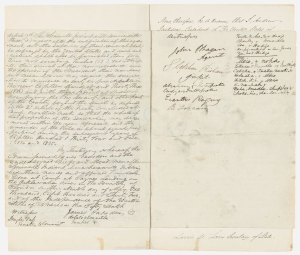
Handwritten page from the treaty signed at Payne's Landing.
Treaty Between the United States and the Seminole Indians Signed at Payne's Landing, Ocklawaha River, Florida Territory, 9 May 1832, National Archives at Washington, DC, 146213769.
May 9, 1832
Treaty of Payne's Landing

On May 9, 1832, several Seminole leaders and the U.S. government signed a treaty demanding the Seminoles leave their home in Florida, which was not yet a U.S. state, and move west of the Mississippi River. This was part of the Trail of Tears.

Learn More

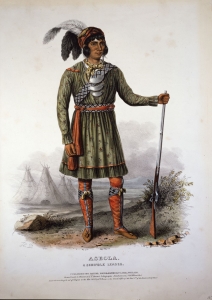
Osceola.
Daniel Rice and James G. Clark, Asceola, A Seminole Leader, 1842, Florida Memory, Reference Collection, RCN00471.
December 28, 1835
Second Seminole War Begins

Three years earlier, several Seminole leaders signed a treaty with the U.S. government agreeing to leave Florida, but other leaders disagreed and chose to stay and fight. On December 28, 1835, Seminole warriors attacked a group of U.S. troops moving through central Florida, which started the Second Seminole War.

Learn More