Florida Memory is administered by the Florida Department of State, Division of Library and Information Services, Bureau of Archives and Records Management. The digitized records on Florida Memory come from the collections of the State Archives of Florida and the special collections of the State Library of Florida.
World War I began on July 28, 1914, after Austria-Hungary declared war on Serbia following the assassination of Archduke Franz Ferdinand of Austria by a Bosnian Serb. The United States declared war on the German Empire on April 6, 1917, in response to attacks on American ships by German U-boats and the discovery of a secret offer from Germany to Mexico to help them take back land in the Southwestern United States that Mexico had lost during the Mexican-American War almost 70 years earlier. This marked America's entry into World War I.
It was the first conflict to include fighting across multiple continents, at sea and in the air. At the time, it was called the Great War, and some people were so stunned by the size and scope that they called it "the war to end all wars." Unfortunately, when World War I ended there were many unresolved issues and tensions between nations that only built as the years went by.
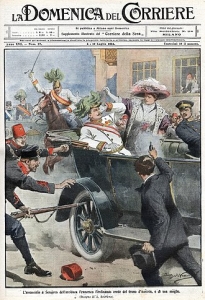
Achille Beltrame, Assassination of Franz Ferdinand, 1863-1914 Archduke of Austria, and his wife Sophie, in Sarajevo, Bosnia, 28 June 1914, [12 July 1914], Wikimedia Commons, Public Domain, DC-1914-27-d-Sarajevo.
June 28, 1914
Assassination of Archduke Franz Ferdinand and Duchess Sophie
On June 28, 1914, Archduke Franz Ferdinand, heir of the Austro-Hungarian Empire, and his wife Sophie, Duchess of Hohenberg, were assassinated by a secret group of Serbian nationalists called the Black Hand. When Austria-Hungary declared war on Serbia a month later, alliances between European powers drove other nations to declare their loyalties to either Serbia or Austria-Hungary.
Examine causes, course, and consequences of United States involvement in World War I.
Examples may include, but are not limited to, nationalism, imperialism, militarism, entangling alliances vs. neutrality, Zimmerman Note, the Lusitania, the Selective Service Act, the homefront, the American Expeditionary Force, Wilson's Fourteen Points, the Treaty of Versailles (and opposition to it), isolationism.
02/14
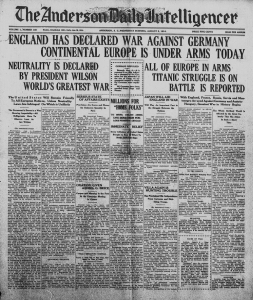
[Frontpage of The Anderson Daily Intelligencer], 5 August 1914, Library of Congress, Chronicling America, sn93067669.
August 4, 1914
President Wilson Declares American Neutrality in War
As war began in Europe, President Woodrow Wilson declared on August 4, 1914, that the United States would remain neutral. At the time, many Americans supported the president's decision, but attitudes began to shift as the war progressed.
Learn More
"Arguing Over War," in Echoes of the Great War: American Experiences of World War I (Library of Congress, n.d.).
Examine causes, course, and consequences of United States involvement in World War I.
Examples may include, but are not limited to, nationalism, imperialism, militarism, entangling alliances vs. neutrality, Zimmerman Note, the Lusitania, the Selective Service Act, the homefront, the American Expeditionary Force, Wilson's Fourteen Points, the Treaty of Versailles (and opposition to it), isolationism.
02/14
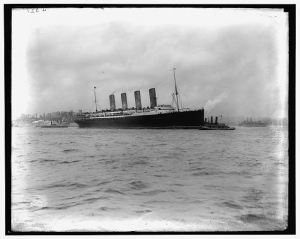
Detroit Publishing Co., The Lusitania, c1907, Library of Congress, Detroit Publishing Company Photograph Collection, 2016806378.
May 7, 1915
The Sinking of the Lusitania
On May 7, 1915, a German U-boat sank the RMS Lusitania, a British ocean liner, off the coast of Ireland. Over 1,000 people died, including 100 U.S. citizens, while 767 escaped in lifeboats. The loss of American life increased the American public's support for joining the war.
Learn More
Robert Brammer, "The Sinking of the Lusitania," In Custodia Legis, May 29, 2015, https://blogs.loc.gov/law/2015/05/the-sinking-of-the-lusitania/.
Examine causes, course, and consequences of United States involvement in World War I.
Examples may include, but are not limited to, nationalism, imperialism, militarism, entangling alliances vs. neutrality, Zimmerman Note, the Lusitania, the Selective Service Act, the homefront, the American Expeditionary Force, Wilson's Fourteen Points, the Treaty of Versailles (and opposition to it), isolationism.
02/14
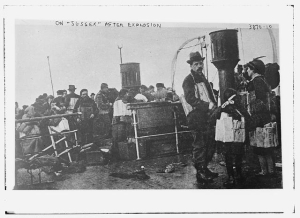
On Sussex After Explosion, [1916], Library of Congress, Bain News Service Photograph Collection, 2014701801.
May 4, 1916
Germany Issues the Sussex Pledge
After a German submarine torpedoed the SS Sussex, a French passenger ferry, on March 24, 1916, the German government promised to stop attacking nonmilitary ships and issued the Sussex Pledge on May 4, 1916. The attack on the SS Sussex killed 50 people and injured hundreds, including several Americans. President Woodrow Wilson warned that continued attacks on civilians would force the United States to declare war on Germany.
Learn More
Simone De Santiago Ramos, "Sussex Pledge," in 1914-1918-Online. International Encyclopedia of the First World War (Freie Universität Berlin, 2015)
Examine causes, course, and consequences of United States involvement in World War I.
Examples may include, but are not limited to, nationalism, imperialism, militarism, entangling alliances vs. neutrality, Zimmerman Note, the Lusitania, the Selective Service Act, the homefront, the American Expeditionary Force, Wilson's Fourteen Points, the Treaty of Versailles (and opposition to it), isolationism.
02/14
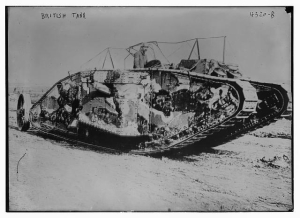
British Tank, 25 September 1916, Library of Congress, George Grantham Bain Collection, 2014705407.
September 15, 1916
First Use of Tanks in Combat
On September 15, 1916, the British Army used tanks on the battlefield for the first time at the Battle of Flers-Courcelette. Most of the tanks got stuck, broke down, or were destroyed by enemy fire. Improvements on the new technology turned tanks into a key tool in mobile warfare, helping ground troops move more quickly instead of waiting in trenches.
Examine the impact of airplanes, battleships, new weaponry and chemical warfare in creating new war strategies (trench warfare, convoys).
02/14
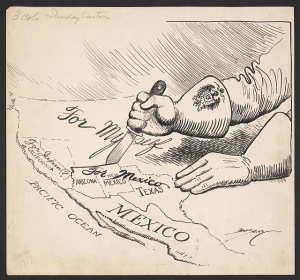
Clifford Kennedy Berryman, [Hand Carving Up a Map of the Southwestern United States], 4 March 1917, Library of Congress, Cartoon Drawings, 2016678747.
January 17, 1917
Britain Intercepts the Zimmerman Telegram
The Zimmerman telegram or note was a coded message sent from German Foreign Secretary Arthur Zimmermann to the German ambassador to Mexico proposing an alliance against the United States.
Learn More
"Zimmermann Telegram (1917)," U.S. National Archives and Records Administration, last modified August 22, 2022.
Examine causes, course, and consequences of United States involvement in World War I.
Examples may include, but are not limited to, nationalism, imperialism, militarism, entangling alliances vs. neutrality, Zimmerman Note, the Lusitania, the Selective Service Act, the homefront, the American Expeditionary Force, Wilson's Fourteen Points, the Treaty of Versailles (and opposition to it), isolationism.
02/14
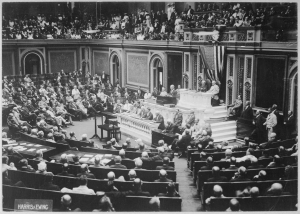
Harris & Ewing, President Wilson Before Congress, Announcing the Break in the Official Relations With Germany, 3 February 1917, National Archives at College Park, 533722.
April 6, 1917
United States Joins World War I
On April 4, 1917, the United States Senate voted to declare war on the German Empire, and the U.S. House of Representatives followed suit two days later. With Congress and President Woodrow Wilson in agreement, the U.S. formally entered World War I on April 6, 1917. Although the American public had been overwhelmingly in favor of remaining neutral, Germany's continued attacks against U.S. ships had changed public opinion.
Examine causes, course, and consequences of United States involvement in World War I.
Examples may include, but are not limited to, nationalism, imperialism, militarism, entangling alliances vs. neutrality, Zimmerman Note, the Lusitania, the Selective Service Act, the homefront, the American Expeditionary Force, Wilson's Fourteen Points, the Treaty of Versailles (and opposition to it), isolationism.
02/14
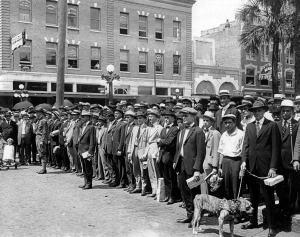
Burgert Brothers, Draftees Assembled During World War I - Tampa, Florida, 1917, Florida Memory, Reference Collection, RC21497.
May 18, 1917
65th Congress Passes the Selective Service Act
The Selective Service Act temporarily gave the federal government the power to expand the U.S. military through conscription, also called a draft. Of all the U.S. troops sent to Europe during World War I, more than half (2.8 million) had been drafted.
Examine causes, course, and consequences of United States involvement in World War I.
Examples may include, but are not limited to, nationalism, imperialism, militarism, entangling alliances vs. neutrality, Zimmerman Note, the Lusitania, the Selective Service Act, the homefront, the American Expeditionary Force, Wilson's Fourteen Points, the Treaty of Versailles (and opposition to it), isolationism.
Examine how the United States government prepared the nation for war with war measures (Selective Service Act, War Industries Board, war bonds, Espionage Act, Sedition Act, Committee of Public Information).
02/14
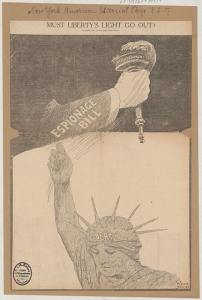
Winsor McCay, Must Liberty's Light Go Out?, 3 May 1917, Library of Congress, 96519622.
June 15, 1917
65th United States Congress Passes the Espionage Act
On June 15, 1917, the 65th United States Congress passed the Espionage Act. Under the act, espionage (or spying) included any activity that could threaten the country's military operations, including recruitment, or anything that could help an enemy nation. The act put new limits on Americans' First Amendment rights.
Examine how the United States government prepared the nation for war with war measures (Selective Service Act, War Industries Board, war bonds, Espionage Act, Sedition Act, Committee of Public Information).
02/14
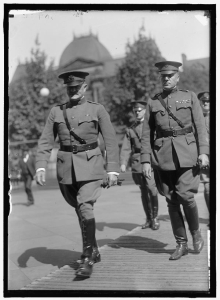
Harris & Ewing, First Division, A.E.F. American Expeditionary Forces. General Pershing, 1919, Library of Congress, Harris & Ewing Photograph Collection, 2016870460.
July 5, 1917
Creation of the American Expeditionary Forces
When the United States declared war on Germany on April 6, 1917, the country had under 130,000 soldiers and officers in its army. The American Expeditionary Forces were established on July 5, 1917, to fight on the Western Front.
Examine causes, course, and consequences of United States involvement in World War I.
Examples may include, but are not limited to, nationalism, imperialism, militarism, entangling alliances vs. neutrality, Zimmerman Note, the Lusitania, the Selective Service Act, the homefront, the American Expeditionary Force, Wilson's Fourteen Points, the Treaty of Versailles (and opposition to it), isolationism.
02/14
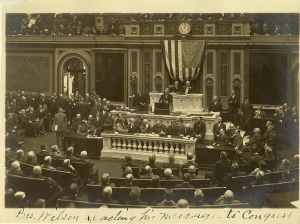
Wilson Addressing Congress on the Fourteen Points, 8 January [1919], Wikimedia Commons, Woodrow Wilson Presidential Library Archives, 4435105235.
January 8, 1918
President Wilson Introduces His Fourteen Points to Congress
During a speech to Congress on January 8, 1918, President Woodrow Wilson outlined his Fourteen Points. Some of the key points focused on getting rid of secret treaties between nations, reducing the armaments (the military weapons and equipment) each nation had, allowing for free trade, and creating the League of Nations.
Examine causes, course, and consequences of United States involvement in World War I.
Examples may include, but are not limited to, nationalism, imperialism, militarism, entangling alliances vs. neutrality, Zimmerman Note, the Lusitania, the Selective Service Act, the homefront, the American Expeditionary Force, Wilson's Fourteen Points, the Treaty of Versailles (and opposition to it), isolationism.
02/14
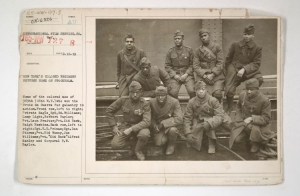
International Film Service, Colored Troops - New York's Colored Regiment Returns Home on Stockholm, 12 February 1919, National Archives at College Park, American Unofficial Collection of World War I Photographs, 26431282.
April 8, 1918
Harlem Hellfighters Join the French Army on the Front Lines
The 369th Infantry Regiment, or the Harlem Hellfighters, was an African American regiment that became one of the first American regiments in World War I. On April 8, 1918, they were assigned to serve with the French Army and would later earn the Croix de Guerre, France's highest military honor, for their bravery. Despite this, they faced racism and discrimination both during and after the war.
Compare the experiences Americans (African Americans, Hispanics, Asians, women, conscientious objectors) had while serving in Europe.
02/14
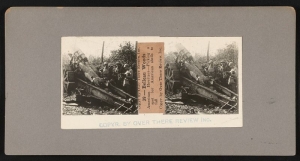
Belleau Woods. American Howitzer - Picking a Spot for American Shells to Fall, 1926, Library of Congress, 2023638420.
June 6, 1918
Allies Attack German Forces at the Battle of Belleau Wood
On June 6, 1918, the Allies moved to drive the German forces out of Belleau Wood and stop them from getting closer to Paris. Both the U.S. Army and Marines fought at Belleau Wood alongside troops from the French and British armies. The Allies won after three weeks of fighting.
Examine causes, course, and consequences of United States involvement in World War I.
Examples may include, but are not limited to, nationalism, imperialism, militarism, entangling alliances vs. neutrality, Zimmerman Note, the Lusitania, the Selective Service Act, the homefront, the American Expeditionary Force, Wilson's Fourteen Points, the Treaty of Versailles (and opposition to it), isolationism.
These primary source sets contain documents and photos arranged by topic that teachers can use in their lesson plans. Each set is accompanied by a teacher's guide containing historical context, teaching suggestions, and relevant NGSSS and Florida Standards.

 Listen: The World Program