Florida Memory is administered by the Florida Department of State, Division of Library and Information Services, Bureau of Archives and Records Management. The digitized records on Florida Memory come from the collections of the State Archives of Florida and the special collections of the State Library of Florida.
Most historians agree the American Revolution started in 1765 when Great Britain passed the Stamp Act. In the ten years between the Stamp Act and the outbreak of war in 1775, people in the Thirteen Colonies became increasingly unhappy with Great Britain's leadership. The Revolutionary War was the official rebellion that led to the birth of a new nation.
The Declaration of Independence was signed July 4, 1776. George Washington became the first U.S. president in 1789, and over the next 20 years the new nation's political leaders set out to give shape to the American Republic.
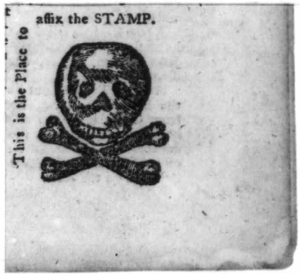
William Bradford, This Is the Place to Affix the Stamp, [24 October 1765], Library of Congress, 2004672606.
March 22, 1765
The Stamp Act
Great Britain was in deep debt after the French and Indian War, so the Parliament of Great Britain passed the Duties in American Colonies Act 1765, also known as the Stamp Act. It was the first direct tax on the American Colonies and required the colonists to pay taxes on certain paper products, including playing cards, newspapers, magazines and legal documents.
Learn More
"The Stamp Act, 1765," The Gilder Lehrman Institute of American History, accessed August 14, 2025.
Identify and explain significant events leading up to the American Revolution.
Examples may include, but are not limited to, the French and Indian War, the Stamp Act, the Townshend Acts, the Boston Massacre, the Boston Tea Party, the Coercive Acts, the Powder Alarms.
Explain the consequences of the French and Indian War in British policies for the American colonies from 1763 - 1774.
Examples may include, but are not limited to, Proclamation of 1763, Sugar Act, Quartering Act, Stamp Act, Declaratory Act, Townshend Acts, Tea Act, Quebec Act, and Coercive Acts.
02/14
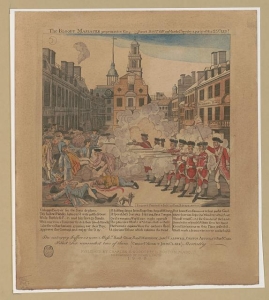
Sidney Lawton Smith, The Bloody Massacre Perpetrated in King - Street Boston on March 5th, 1770, by a Party of the 29th Regt., 1908, Library of Congress, Popular Graphic Arts Collection, 2012648847.
March 5, 1770
The Boston Massacre
On March 5, 1770, British soldiers guarding the Boston Custom House shot into a crowd of civilians, killing three men and injuring eight. Two out of the eight injured people died later.
Identify the economic, political and socio-cultural motivation for colonial settlement.
Examples may include, but are not limited to, Puritans, Quakers, and Catholics fleeing from religious persecution, debtor settlements in Georgia, military stronghold and protection of trade routes at St. Augustine, establishment of the Jamestown colony for profit, and French and Dutch competition for the fur trade..
Explain American colonial reaction to British policy from 1763 - 1774.
Examples may include, but are not limited to, written protests, boycotts, unrest leading to the Boston Massacre, Boston Tea Party, First Continental Congress, Stamp Act Congress, Committees of Correspondence.
02/14
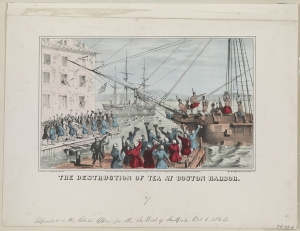
Sarony & Major, The Destruction of Tea at Boston Harbor, 1 October 1846, Library of Congress, Popular Graphic Arts Collection, 2003664100.
December 16, 1773
Boston Tea Party
On December 16, 1773, a group of American colonists boarded three merchant ships and dumped 342 chests of tea into Boston Harbor in protest of the Tea Act. Some painted their faces and attempted to dress as Native Americans to disguise themselves.
Identify the economic, political and socio-cultural motivation for colonial settlement.
Examples may include, but are not limited to, Puritans, Quakers, and Catholics fleeing from religious persecution, debtor settlements in Georgia, military stronghold and protection of trade routes at St. Augustine, establishment of the Jamestown colony for profit, and French and Dutch competition for the fur trade..
Explain American colonial reaction to British policy from 1763 - 1774.
Examples may include, but are not limited to, written protests, boycotts, unrest leading to the Boston Massacre, Boston Tea Party, First Continental Congress, Stamp Act Congress, Committees of Correspondence.
02/14
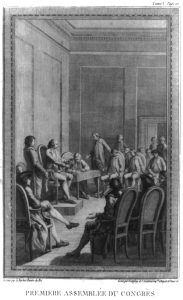
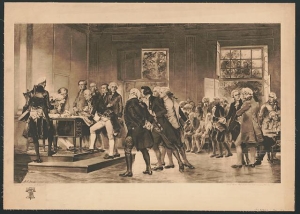
François Godefroy, Premiere Assemblée du Congrès, [1782], Library of Congress, 2004670031.
September 5, 1774
First Continental Congress Established
In early 1774, the British Parliament passed the Intolerable Acts (also called the Coercive Acts) as punishment for the Boston Tea Party. On September 5, 1774, twelve of the Thirteen Colonies sent delegates to the First Continental Congress in Philadelphia to create a unified response to the rising tension with Britain. Loyalists outnumbered Patriots in Georgia, so it was the only colony that did not send any delegates. In total, 56 delegates attended the meeting.
Learn More
Katherine Horan and Zoie Horecny, "First Continental Congress," in The Digital Encyclopedia of George Washington, ed. Zoie Horecny and Alexandra Montgomery (Mount Vernon Ladies' Association, 2025), accessed September 5, 2025.
Standards related to colonial responses to British policies and significant figures in the American Revolution
Identify significant individuals and groups who played a role in the American Revolution.
Examples may include, but are not limited to, King George III, Patrick Henry, Thomas Jefferson, George Washington, John Adams, John Hancock, Crispus Attucks, Ben Franklin, Paul Revere and Patriots, Sons of Liberty, Daughters of Liberty, Continental Congress, James Armistead, Francis Marion,
Explain American colonial reaction to British policy from 1763 - 1774.
Examples may include, but are not limited to, written protests, boycotts, unrest leading to the Boston Massacre, Boston Tea Party, First Continental Congress, Stamp Act Congress, Committees of Correspondence.
02/14
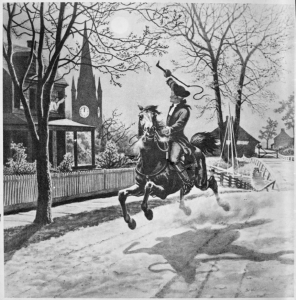
Paul Revere's Ride, National Archives at College Park, 535721.
April 18, 1775
Paul Revere's Midnight Ride
On the night of April 18, 1775, Paul Revere rode through the Massachusetts countryside to warn the Patriots of a British attack on the towns of Lexington and Concord. Revere and William Dawes Jr., another member of the Sons of Liberty, split up to warn people on their way to Lexington. In Lexington, they were joined by Dr. Samuel Prescott. Revere was arrested by the British on the way to Concord, but Dawes and Prescott escaped.
Identify significant individuals and groups who played a role in the American Revolution.
Examples may include, but are not limited to, King George III, Patrick Henry, Thomas Jefferson, George Washington, John Adams, John Hancock, Crispus Attucks, Ben Franklin, Paul Revere and Patriots, Sons of Liberty, Daughters of Liberty, Continental Congress, James Armistead, Francis Marion,
02/14
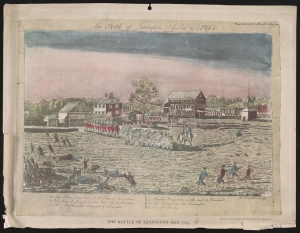
Amos Doolittle, The Battle of Lexington April 1775, [between 1940 and 1950], Library of Congress, Marian S. Carson Collection, 2015650276.
April 19, 1775
Battles of Lexington and Concord
On April 19, 1775, British troops marched into Lexington and were greeted by local militia men (or a military force made up of civilians). No one knows who fired the first shot, but history remembers it as the "shot heard 'round the world." The British overwhelmed the local militia and continued toward Concord. At Concord's North Bridge, the Patriots fired onto the British troops and forced them to retreat to Boston.
Examine and compare major battles and military campaigns of the American Revolution.
Examples may include, but are not limited to, Lexington and Concord, Saratoga, Valley Forge, Yorktown, Savannah, Charleston, Trenton, Princeton, Bunker Hill.
Examine the causes, course, and consequences of the American Revolution.
Examples may include, but are not limited to, Battles of Lexington and Concord, Common Sense, Second Continental Congress, Battle of Bunker Hill, Battle of Cowpens, Battle of Trenton, Olive Branch Petition, Declaration of Independence, winter at Valley Forge, Battles of Saratoga and Yorktown, Treaty of Paris.
02/14
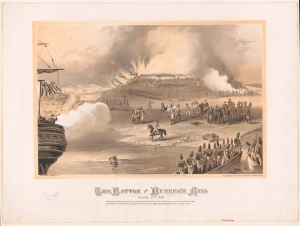
Henry A. Thomas, The Battle at Bunker's Hill, c1875, Library of Congress, 2006691566.
June 17, 1775
Battle of Bunker Hill
On June 17, 1775, the British defeated the United Colonies. Although the battle was technically a victory for the British, more than 800 British soldiers were killed and 200 were injured. The colonists did not lose as many people and might have seen the British losses as a sign they could eventually win the war.
Examine and compare major battles and military campaigns of the American Revolution.
Examples may include, but are not limited to, Lexington and Concord, Saratoga, Valley Forge, Yorktown, Savannah, Charleston, Trenton, Princeton, Bunker Hill.
Examine the causes, course, and consequences of the American Revolution.
Examples may include, but are not limited to, Battles of Lexington and Concord, Common Sense, Second Continental Congress, Battle of Bunker Hill, Battle of Cowpens, Battle of Trenton, Olive Branch Petition, Declaration of Independence, winter at Valley Forge, Battles of Saratoga and Yorktown, Treaty of Paris.
02/14
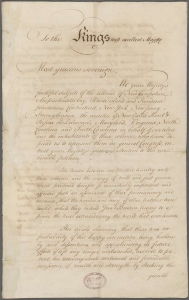
Petition to George III, King of Great Britain, 1775, The New York Public Library Digital Collections, Manuscripts and Archives Division, 5208520.
July 8, 1775
Second Continental Congress Signs the Olive Branch Petition
In the summer of 1775, the Second Continental Congress met in Philadelphia and drafted the Olive Branch Petition as a last attempt to make peace between the Thirteen Colonies and Great Britain, even though the fighting had already begun. King George III refused to read the petition and declared the colonists to be traitors in open rebellion.
Identify and explain significant events leading up to the American Revolution.
Examples may include, but are not limited to, the French and Indian War, the Stamp Act, the Townshend Acts, the Boston Massacre, the Boston Tea Party, the Coercive Acts, the Powder Alarms.
02/14
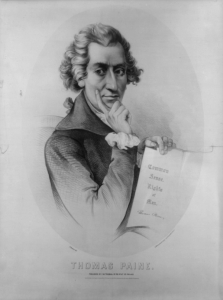
Peter Krämer, Thomas Paine, 1851, Library of Congress, 2008676231.
January 10, 1776
Thomas Paine Anonymously Publishes Common Sense
On January 10, 1776, Thomas Paine anonymously published Common Sense. The 47-page pamphlet explained why the Thirteen Colonies should be independent from Great Britain. It argued in favor of a strong central government that was designed to serve the people. The pamphlet was a bestseller and helped the colonial public see the value of independence.
Explain the significance of historical documents including key political concepts, origins of these concepts, and their role in American independence.
Examples may include, but are not limited to, the Magna Carta, the English Bill of Rights, the Mayflower Compact, Common Sense, the Declaration of Independence.
Examine the causes, course, and consequences of the American Revolution.
Examples may include, but are not limited to, Battles of Lexington and Concord, Common Sense, Second Continental Congress, Battle of Bunker Hill, Battle of Cowpens, Battle of Trenton, Olive Branch Petition, Declaration of Independence, winter at Valley Forge, Battles of Saratoga and Yorktown, Treaty of Paris.
02/14
S. Dodson, Signing the Declaration of Independence, 1912, Library of Congress, Popular Graphic Arts Collection, 2018757150.
July 4, 1776
Adoption of the Declaration of Independence
On July 4, 1776, the Second Continental Congress adopted the Declaration of Independence, which laid out the principles of American government. East and West Florida were also British colonies during 1776, but both colonies chose to remain loyal to Great Britain.
Explain the significance of historical documents including key political concepts, origins of these concepts, and their role in American independence.
Examples may include, but are not limited to, the Magna Carta, the English Bill of Rights, the Mayflower Compact, Common Sense, the Declaration of Independence.
02/14
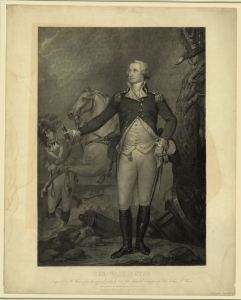
William Warner and John Trumbull, Gen. Washington (on the Battle Field at Trenton), ca. 1845, Library of Congress, 2006678634.
December 26, 1776
Battle of Trenton
General George Washington led 2,400 soldiers across the Delaware River on Christmas night 1776 and marched ten miles to the city of Trenton, New Jersey, on December 26, 1776, to attack the Hessians (German soldiers who fought for the British). Washington and his army captured most of the Hessians and won the battle. It was a key victory for Washington's image as a leader and boosted the morale of American troops.
Learn More
Cody Lass, "Battle of Trenton," in The Digital Encyclopedia of George Washington, ed. Zoie Horecny and Alexandra Montgomery (Mount Vernon Ladies' Association, 2025), accessed August 25, 2025.
Mark Thompson, "Battle of Trenton," EBSCO Research Starters, last modified 2023.
Examine and compare major battles and military campaigns of the American Revolution.
Examples may include, but are not limited to, Lexington and Concord, Saratoga, Valley Forge, Yorktown, Savannah, Charleston, Trenton, Princeton, Bunker Hill.
Examine the causes, course, and consequences of the American Revolution.
Examples may include, but are not limited to, Battles of Lexington and Concord, Common Sense, Second Continental Congress, Battle of Bunker Hill, Battle of Cowpens, Battle of Trenton, Olive Branch Petition, Declaration of Independence, winter at Valley Forge, Battles of Saratoga and Yorktown, Treaty of Paris.
02/14
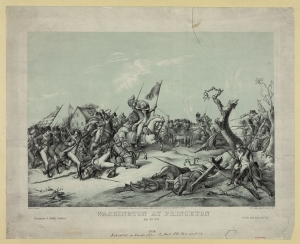
Brückner and D. Mclellan, Washington at Princeton. Jany. 3rd. 1777, c1853 Feb. 10, Library of Congress, Popular Graphic Arts Collection, 2003671527.
January 3, 1777
Battle of Princeton
American defeats during the New York Campaign of 1776 had cast doubt on the chances for an American victory in the war for independence, but Washington's victories at the Battle of Princeton and the Battle of Trenton eight days earlier renewed American hopes. The time between Washington's crossing of the Delaware River on December 25, 1776, and the victory at Princeton are called the Ten Crucial Days.
Learn More
Joseph F., III Stoltz, "Battle of Princeton," in The Digital Encyclopedia of George Washington, ed. Zoie Horecny and Alexandra Montgomery (Mount Vernon Ladies' Association, 2012), accessed September 8, 2025.
Examine and compare major battles and military campaigns of the American Revolution.
Examples may include, but are not limited to, Lexington and Concord, Saratoga, Valley Forge, Yorktown, Savannah, Charleston, Trenton, Princeton, Bunker Hill.
Examine the causes, course, and consequences of the American Revolution.
Examples may include, but are not limited to, Battles of Lexington and Concord, Common Sense, Second Continental Congress, Battle of Bunker Hill, Battle of Cowpens, Battle of Trenton, Olive Branch Petition, Declaration of Independence, winter at Valley Forge, Battles of Saratoga and Yorktown, Treaty of Paris.
02/14
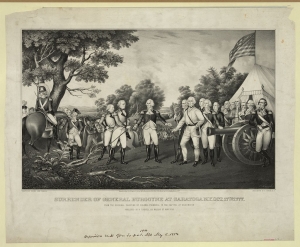
N. Currier and John Trumbull, Surrender of General Burgoyne at Saratoga N.Y. Oct. 17th. 1777, c1852, Library of Congress, 2002695771.
October 7, 1777
Americans Win the Battles of Saratoga
The Battles of Saratoga were the two major battles that defined a month-long fight between the British and the Americans to control the Hudson River Valley. The first battle occurred on September 19 and ended in victory for the British. Yet, the British lost nearly 600 soldiers. With no reinforcements, their second attack failed, and the Americans forced the British to retreat on October 7, 1777.
Learn More
Troy Smith, "Battle of Saratoga," in The Digital Encyclopedia of George Washington, ed. Zoie Horecny and Alexandra Montgomery (Mount Vernon Ladies' Association, 2012), accessed August 26, 2025.
Examine and compare major battles and military campaigns of the American Revolution.
Examples may include, but are not limited to, Lexington and Concord, Saratoga, Valley Forge, Yorktown, Savannah, Charleston, Trenton, Princeton, Bunker Hill.
Examine the causes, course, and consequences of the American Revolution.
Examples may include, but are not limited to, Battles of Lexington and Concord, Common Sense, Second Continental Congress, Battle of Bunker Hill, Battle of Cowpens, Battle of Trenton, Olive Branch Petition, Declaration of Independence, winter at Valley Forge, Battles of Saratoga and Yorktown, Treaty of Paris.
02/14
Colonel [William Augustine] Washington at the Battle of Cowpens. January 1781. Copy of print by S. H. Gimber, National Archives at College Park, 532886.
January 17, 1781
Battle of Cowpens
The British had gained the upper hand in the South after capturing Savannah, Georgia and Charleston, South Carolina, but the Battle of Cowpens turned the tide in the war for the southern colonies. On January 17, 1781, under the command of Brigadier General Daniel Morgan, the Americans were able to use a planned retreat to lure the British forward and surround them in a tactic called a double envelope.
Learn More
Roger Adams, "Battle of Cowpens," in The Digital Encyclopedia of George Washington, ed. Zoie Horecny and Alexandra Montgomery (Mount Vernon Ladies' Association, 2012), accessed August 26, 2025.
Examine and compare major battles and military campaigns of the American Revolution.
Examples may include, but are not limited to, Lexington and Concord, Saratoga, Valley Forge, Yorktown, Savannah, Charleston, Trenton, Princeton, Bunker Hill.
Examine the causes, course, and consequences of the American Revolution.
Examples may include, but are not limited to, Battles of Lexington and Concord, Common Sense, Second Continental Congress, Battle of Bunker Hill, Battle of Cowpens, Battle of Trenton, Olive Branch Petition, Declaration of Independence, winter at Valley Forge, Battles of Saratoga and Yorktown, Treaty of Paris.
02/14
Prise de Pensacola, 1810, Florida Memory, Digital Collection, MC12-13, LIB00194.
May 10, 1781
Spanish Win the Siege of Pensacola
East and West Florida remained loyal to the British during the Revolutionary War, but when Spain joined the war as an ally of the colonies, the Spanish fought to take control of West Florida and the Gulf Coast. This led to the Siege of Pensacola, which lasted from March 9, 1781, to May 10, 1781. The Spanish captured British West Florida in May 1781 and formally took control of the area in 1783.
Examine the causes, course, and consequences of the American Revolution.
Examples may include, but are not limited to, Battles of Lexington and Concord, Common Sense, Second Continental Congress, Battle of Bunker Hill, Battle of Cowpens, Battle of Trenton, Olive Branch Petition, Declaration of Independence, winter at Valley Forge, Battles of Saratoga and Yorktown, Treaty of Paris.
02/14
François Godefroy and Nicolas Ponce, [Surrender of Cornwallis at Yorktown], [1784?], Library of Congress, 2004671450.
October 19, 1781
Americans Win the Siege of Yorktown
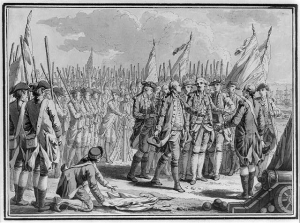
On October 19, 1781, the British Army surrendered to General George Washington and the Continental Army at Yorktown after a month-long battle. French forces provided important naval support, making the Siege of Yorktown a victory for both the French and the Americans over the British. It was the last major land battle of the Revolutionary War.
Learn More
Russell S. Perkins, "Yorktown Campaign," in The Digital Encyclopedia of George Washington, ed. Zoie Horecny and Alexandra Montgomery (Mount Vernon Ladies' Association, 2012).
Examine and compare major battles and military campaigns of the American Revolution.
Examples may include, but are not limited to, Lexington and Concord, Saratoga, Valley Forge, Yorktown, Savannah, Charleston, Trenton, Princeton, Bunker Hill.
Examine the causes, course, and consequences of the American Revolution.
Examples may include, but are not limited to, Battles of Lexington and Concord, Common Sense, Second Continental Congress, Battle of Bunker Hill, Battle of Cowpens, Battle of Trenton, Olive Branch Petition, Declaration of Independence, winter at Valley Forge, Battles of Saratoga and Yorktown, Treaty of Paris.
02/14
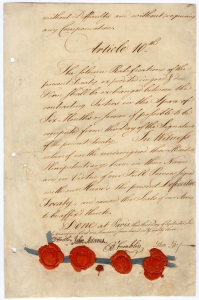
Treaty of Paris, 3 September 1783, National Archives at Washington, DC, 299805.
September 3, 1783
Treaty of Paris Ends the Revolutionary War
On September 3, 1783, representatives from Great Britain and the United States signed the Treaty of Paris. The treaty was part of a set of treaties called the Peace of Paris that formally ended the American Revolutionary War. The Peace of Paris also gave control of East and West Florida back to Spain.
Learn More
"Treaty of Paris (1783)," U.S. National Archives and Records Administration, last modified March 6, 2025.
Standards related to the American Revolution, including events in Florida
Examine the causes, course, and consequences of the American Revolution.
Examples may include, but are not limited to, Battles of Lexington and Concord, Common Sense, Second Continental Congress, Battle of Bunker Hill, Battle of Cowpens, Battle of Trenton, Olive Branch Petition, Declaration of Independence, winter at Valley Forge, Battles of Saratoga and Yorktown, Treaty of Paris.
Examine key events in Florida history as each impacts this era of American history.
Examples may include, but are not limited to, Treaty of Paris, British rule, Second Spanish Period.
02/14
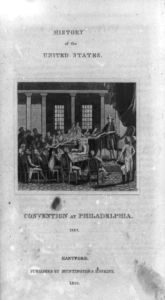
Convention at Philadelphia, 1787, 1823, Library of Congress, 93515362.
June 11, 1787
Three-Fifths Compromise Proposed
During the Constitutional Convention of 1787, Northern and Southern delegates agreed to count five enslaved people as three people when calculating a state's population. Southern states had larger enslaved populations than Northern states, which meant they received more seats in the House of Representatives and more electors in the Electoral College.
Analyze the provisions under the Articles of Confederation and the Constitution regarding slavery.
Clarification 1: Instruction includes how slavery increased through natural reproduction and the smuggling of human contraband, in spite of the desire of the Continental Congress to end the importation of slaves.
Clarification 2: Instruction includes how the Northwest Ordinance of 1785 provided a mechanism for selling and settling the land and laid the foundations of land policy until passage of the Homestead Act of 1862.
Clarification 3: Instruction includes the political issues regarding slavery that were addressed in the Northwest Ordinance of 1787.
Clarification 4: Instruction includes the Three-Fifths Compromise as an agreement between delegates from the northern and the southern states in the Continental Congress (1783) and taken up anew at the United States Constitutional Convention (1787) that required three-fifths of the slave population be counted for determining direct taxation and representation in the House of Representatives.
Explain early congressional actions regarding the institution of slavery (i.e., Northwest Ordinance of 1787, Three-Fifths Compromise, Act Prohibiting Importation of Slaves of 1808).
Examine the course and consequences of the Constitutional Convention (New Jersey Plan, Virginia Plan, Great Compromise, Three-Fifths Compromise, compromises regarding taxation and slave trade, Electoral College, state vs. federal power, empowering a president).
02/14
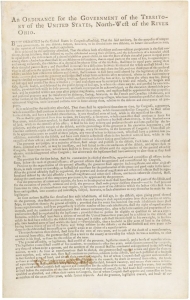
An Ordinance for the Government of the Territory of the United States, North-West of the River Ohio, 13 July 1787, National Archives at Washington, DC, 5730365.
July 13, 1787
The Confederation Congress Adopts the Northwest Ordinance
On July 13, 1787, the Congress of the Confederation (the governing body later replaced by the United States Congress) adopted the Northwest Ordinance. The ordinance created the Northwest Territory and provided a method for admitting new states to the Union from the territory. The ordinance also prohibited slavery in the Northwest Territory, except for as a punishment for a crime.
Learn More
"Northwest Ordinance (1787)," U.S. National Archives and Records Administration, last modified May 10, 2022.
Standards related to land policies and early actions on slavery
Explain early congressional actions regarding the institution of slavery (i.e., Northwest Ordinance of 1787, Three-Fifths Compromise, Act Prohibiting Importation of Slaves of 1808).
05/24
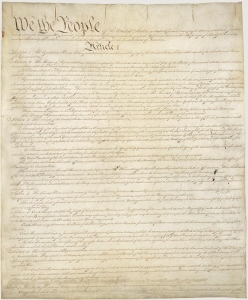
Constitution of the United States, National Archives at Washington, DC, 1667751.
September 17, 1787
38 Delegates Sign the U.S. Constitution
After three months of debate, on September 17, 1787, 38 delegates at the Constitutional Convention in Philadelphia signed the Constitution of the United States of America. It laid the foundation for the U.S. government by outlining its structure, powers, relationship with the states, and the rights of the people.
Examine the significance of the Constitution including its key political concepts, origins of those concepts, and their role in American democracy.
Examples may include, but are not limited to, liberty, representative government, limited government, individual rights, "bundle of compromises."
02/14
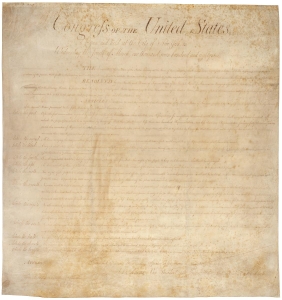
Bill of Rights, 25 September 1789, National Archives at Washington, DC, 1408042.
December 15, 1791
States Ratify the Bill of Rights
The first ten amendments to the U.S. Constitution are called the Bill of Rights. They were added to the Constitution to limit the powers of the federal government and protect the rights of individual citizens. Three fourths of the U.S. states ratified the Bill of Rights by December 15, 1791.
Learn More
"The Bill of Rights," U.S. National Archives and Records Administration, last modified April 21, 2023.
Analyze support and opposition (Federalists, Federalist Papers, Anti-Federalists, Bill of Rights) to ratification of the U.S. Constitution.
02/14
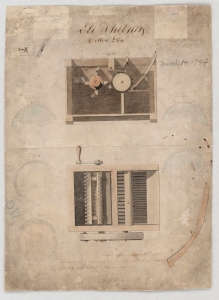
Eli Whitney. Cotton Gin, 14 March 1794, National Archives at College Park, 102278457.
March 14, 1794
Eli Whitney Patents the Cotton Gin
In 1794, Eli Whitney patented the cotton gin (or cotton engine), a machine that could quickly separate cotton fibers and seeds. Cotton became cheaper and easier to produce. In consequence, the size and number of plantations grew across the American South, leading to an increase in the use of enslaved labor in the region.
Identify technological improvements (inventions/inventors) that contributed to industrial growth.
Examples may include, but are not limited to, Fitch/steamboat, Slater/textile mill machinery, Whitney/cotton gin, interchangeable parts, McCoy/industrial lubrication, Fulton/commercial steamboat, Lowell/mechanized cotton mill, Isaac Singer/sewing machine.
02/14
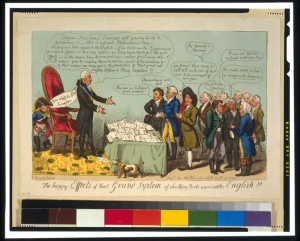
George Cruikshank, The Happy Effects of That Grand Systom [sic] of Shutting Ports Against the English!!, 1808, Library of Congress, British Cartoon Prints Collection, 99401790.
December 22, 1807
10th United States Congress Passes the Embargo Act
During the Napoleonic Wars, Britain and France targeted American merchant ships to disrupt each other's trade. On December 22, 1807, the 10th United States Congress signed the Embargo Act into law, which banned American ships from participating in trade with any foreign nation, stopped U.S. ports from exporting goods, and put restrictions on imports from Britain. The embargo damaged the U.S. economy and led to a rise in smuggling.
Learn More
Stephen F. Knott, "The Embargo Act," Teaching American History, accessed September 8, 2025.
Standards related to Thomas Jefferson's presidency
Explain major domestic and international economic, military, political, and socio-cultural events of Thomas Jefferson's presidency.
Examples may include, but are not limited to, Election of 1800, birth of political parties, Marbury v. Madison, judicial review, Jefferson's First Inaugural Address, Judiciary Act of 1801, Louisiana Purchase, Barbary War, Lewis and Clark Expedition, Hamilton and Burr conflict/duel, Embargo of 1807.
These primary source sets contain documents and photos arranged by topic that teachers can use in their lesson plans. Each set is accompanied by a teacher's guide containing historical context, teaching suggestions, and relevant NGSSS and Florida Standards.

 Listen: The World Program